MSc thesis · University of Oxford · Text, measurement & social science
Armed Conflict and State Policy Preferences: A Statistical and Neural Embedding Approach
MSc thesis · University of Oxford
MSc in Social Data Science, Oxford Internet Institute, University of Oxford (2021)
Original abstract
The usage of natural language processing (NLP) has been increasing in the social sciences. The existing NLP methods enable researchers to train models that offer high predictive performance in various tasks. However, many social science questions are interested in explanations as opposed to predictions. This is a particularly challenging task in observational studies, where researchers must control for and isolate many (often unobserved or unknown) effects. To the best of my knowledge, text data has not been used in observational, multi-level panel data regression frameworks. This thesis aims to address this gap. I combine the state-of-the-art NLP techniques with existing econometric methods and build a framework for testing the relationship between information embedded in text data and desired response variables while controlling for other factors. I introduce this methodology by performing a case study that explores the relationship between armed conflict and state policy preferences, where policy preferences are extracted from the annual speeches of leaders at the UN General Debate. The methodological pipeline contains three broad steps. First, I train my own word embeddings and build a topic model, where each topic represents a specific policy theme. Second, I develop a policy-theme semantic index that describes how well each speech is semantically related to each topic using neural word and sentence embeddings. Third, I use these indices in a panel data regression equation, testing which policy-theme semantic indices best explain variation in armed conflict. I use a number of socioeconomic factors as control variables. The thesis makes several important contributions. First, it extends the framework of clustering word embeddings to clustering sentence embeddings for topic modeling. Second, it finds that sentence embeddings are more stable than word embeddings. Third, it builds an econometric-NLP framework for constructing indices from text and testing hypotheses in panel datasets. Fourth, it showcases that the results achieved by econometric- and machine learning-based predictions differ using the same data, highlighting the importance of using appropriate statistical tools in panel datasets. The presented framework can be used by researchers who wish to study observational, cross-sectional and time-series problems that involve text data.
This Oxford MSc thesis connects neural text representations with econometric panel analysis. It builds policy-theme indices from UN General Debate speeches, tests their stability, and studies their relationship with armed conflict while accounting for socioeconomic factors.
How can political text become evidence in a panel-data study?#
Text contains information about what governments emphasize, but turning speeches into variables for statistical analysis requires several choices. A researcher must define topics, measure how strongly each speech relates to them, and decide how those measurements enter a model of the outcome of interest.
This 2021 Oxford MSc thesis develops a pipeline linking neural text embeddings and econometric panel analysis. Its case study examines armed conflict and state policy preferences using leaders’ annual speeches at the United Nations General Debate. The methodological question is how to connect information in text with repeated country-level observations while accounting for other measured factors.
The thesis is an early contribution in computational social science within this collection. It should be read as an MSc thesis, rather than as a conference paper or a study of modern instruction-tuned language models.
From speeches to semantic policy indices#
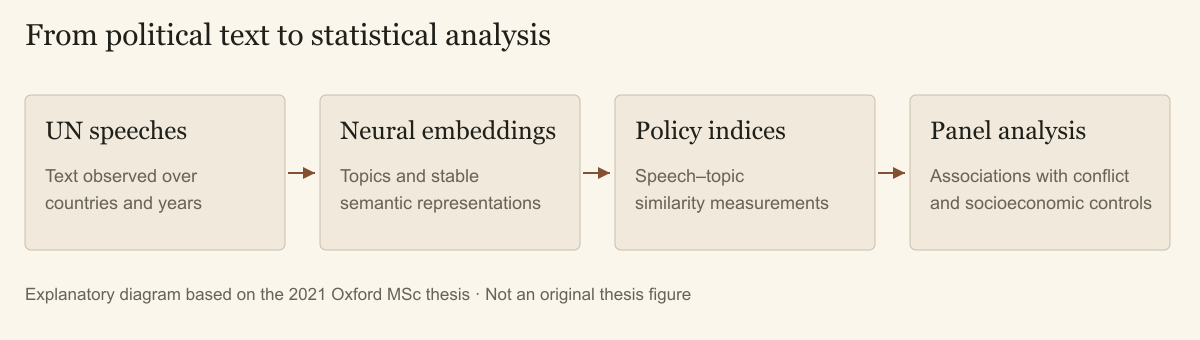
Explanatory diagram created for this page from the thesis’s methodology. It is not an original thesis figure. Source: author-uploaded thesis, Chapter 3.
The pipeline has three broad stages. First, it constructs and evaluates topic representations using word and sentence embeddings. A topic represents a policy theme. The thesis examines clustering approaches and the question of how to interpret the resulting groups of words or sentences.
Second, it builds a semantic policy index for a topic and speech. The index measures how closely the speech is semantically related to that theme. This produces numeric variables that can be compared across speeches and incorporated into subsequent statistical models.
Third, the indices enter a panel-data analysis alongside socioeconomic controls. The case study connects speech-derived measurements with whether a country is involved in armed conflict during the relevant year. The thesis also compares these analyses with machine-learning classifiers applied to the same general problem.
Why stability matters before regression#
An index derived from embeddings can vary because of the representation or clustering procedure. If that variation is large, a downstream regression may reflect instability in measurement as well as substantive political differences.
The thesis therefore examines the stability of word embeddings, sentence embeddings and clustering. Its reported results favor sentence-based representations over word-based ones in this setting. This is a measurement finding within the studied pipeline, rather than a general ranking of every possible embedding model.
In the thesis’s conclusion, the strongest evaluated topic-model configuration uses K-means over sentence-level representations constructed from weighted FastText word embeddings. The procedure is grounded in the methods available and evaluated in the 2021 study; this page does not replace it with a later embedding technology.
What the study contributes#
The thesis’s contribution is a connection between representation learning and an explicitly statistical analysis of repeated observations. Its conclusion describes ten topic-model configurations evaluated against seven criteria, robustness checks across fifteen linear mixed-effects specifications, and twenty-five machine-learning classification models.
| Part of the analysis | What it contributes |
|---|---|
| Topic modeling | A way to organize policy themes from political speeches. |
| Stability analysis | Checks on whether the derived representations and clusters are reproducible. |
| Semantic policy indices | Numeric speech-level measures that can enter an econometric model. |
| Panel and predictive models | A comparison of explanatory associations and predictive behavior. |
The thesis finds that econometric and machine-learning approaches can produce different results on the same data. That observation reinforces the importance of choosing a method for the question being asked. Predicting conflict accurately is different from estimating a particular conditional relationship between a text-derived variable and conflict.
What can be inferred from an observational association?#
The study incorporates controls and repeated country-level observations, but these features do not automatically establish causality. Political speeches can respond to conflict as well as precede it, and unmeasured factors can affect both rhetoric and conflict.
It is therefore more accurate to describe the case study as examining relationships between measured policy emphasis and conflict under specified models. The contribution is a framework for constructing and analyzing text-derived variables, rather than proof that changing the wording of a speech would change a country’s conflict risk.
This distinction is useful beyond international relations. Similar measurement problems arise whenever a researcher converts documents into indices and then uses those indices to answer an observational question.
Scope and limitations#
The thesis discusses uncertainty in the number of topics, subjectivity in topic labels, imperfect socioeconomic controls and possible translation noise. It also identifies the joint stability of the full pipeline as a direction for further work.
Speeches measure expressed emphasis, which need not perfectly reveal a government’s underlying preferences or actions. The construction of a semantic index, the aggregation of text, and the regression specification all shape the interpretation of the results.
Questions about the thesis#
Is this the Cambridge PhD thesis?#
No. This is the 2021 MSc thesis in Social Data Science at the Oxford Internet Institute, University of Oxford. It is a separate work from the later Cambridge PhD.
Does the thesis use neural embeddings or a modern chat model?#
It uses neural word and sentence representations to build topic models and semantic indices. The methods should be understood in the context of the original 2021 study.
Does it show that a policy theme causes armed conflict?#
The study analyzes observational relationships with controls. Causal conclusions would require additional identification assumptions and evidence beyond finding a regression association.
Source and reading the thesis#
The author-uploaded ResearchGate record contains the abstract and full thesis text. Chapter 3 describes the methods, Chapters 4–5 discuss results and limitations, and Chapter 6 summarizes the contribution. This page links to that record for the original thesis.
Use in your work
Cite this paper
Cite the original research below. This generated explanation is a reading aid.
Rauba, P. (2021). Armed Conflict and State Policy Preferences: A Statistical and Neural Embedding Approach. MSc in Social Data Science, Oxford Internet Institute, University of Oxford. https://www.researchgate.net/publication/356580919_Armed_Conflict_and_State_Policy_Preferences_A_Statistical_and_Neural_Embedding_Approach
BibTeX
@mastersthesis{rauba2021armedconflict,
  title = {Armed Conflict and State Policy Preferences: A Statistical and Neural Embedding Approach},
  author = {Rauba, Paulius},
  year = {2021},
  school = {University of Oxford},
  type = {MSc thesis in Social Data Science},
  url = {https://www.researchgate.net/publication/356580919_Armed_Conflict_and_State_Policy_Preferences_A_Statistical_and_Neural_Embedding_Approach}
}