Salient model report · arXiv 2026 · Decision-centric forecasting
Probabilistic Transformers for Joint Modeling of Global Weather Dynamics and Decision-Centric Variables
Model report · Salient
Paulius Rauba, Viktor Cikojević, Fran Bartolić and Sam Levang contributed equally.
arXiv (2026) · DOI: 10.48550/arXiv.2601.03753
Original abstract
Weather forecasts sit upstream of high-stakes decisions in domains such as grid operations, aviation, agriculture, and emergency response. Yet forecast users often face a difficult trade-off. Many decision-relevant targets are functionals of the atmospheric state variables, such as extrema, accumulations, and threshold exceedances, rather than state variables themselves. As a result, users must estimate these targets via post-processing, which can be suboptimal and can introduce structural bias. The core issue is that decisions depend on distributions over these functionals that the model is not trained to learn directly. In this work, we introduce GEM-2, a probabilistic transformer that jointly learns global atmospheric dynamics alongside a suite of variables that users directly act upon. Using this training recipe, we show that a lightweight (~275M params) and computationally efficient (~20-100x training speedup relative to state-of-the-art) transformer trained on the CRPS objective can directly outperform operational numerical weather prediction (NWP) models and be competitive with ML models that rely on expensive multi-step diffusion processes or require bespoke multi-stage fine-tuning strategies. We further demonstrate state-of-the-art economic value metrics under decision-theoretic evaluation, stable convergence to climatology at S2S and seasonal timescales, and a surprising insensitivity to many commonly assumed architectural and training design choices.
GEM-2 jointly forecasts atmospheric dynamics and the diagnostic variables that people use to make decisions. Learning targets such as daily extrema directly avoids the structural sampling bias introduced by deriving them from sparse weather snapshots.
Why forecast the variables that people make decisions with?#
A weather model may predict atmospheric snapshots accurately while still giving a user a poor estimate of the quantity they actually need. A farmer may care about the lowest temperature overnight. An energy operator may care about a daily maximum or an accumulated quantity. Those targets are functions of weather over time, rather than necessarily the instantaneous variables used to evolve the forecast.
If a model produces only a few snapshots per day, taking their maximum cannot recover a peak that occurred between them. That is a structural limitation of the estimator, even before accounting for prediction error. The Salient model report studies decision-centric probabilistic forecasting by learning these diagnostic targets directly.
Its model, GEM-2, jointly models global atmospheric dynamics and quantities used in downstream decisions. The claim is tied to the variables, comparisons and economic-value evaluations reported in the paper, rather than a statement that one system is best for every weather task.
Prognostic states and diagnostic targets#
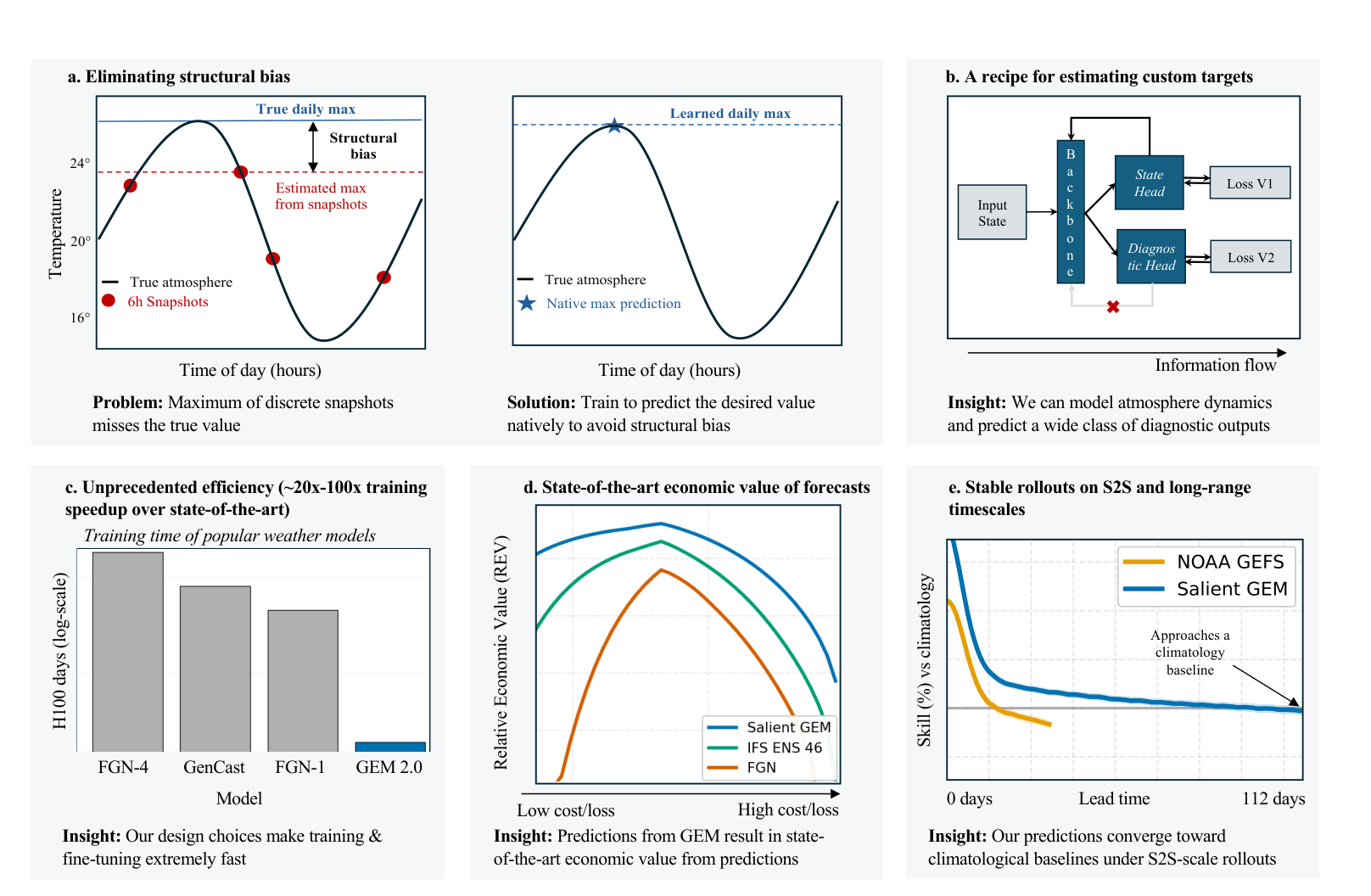
Original Figure 1 summarizes the report. Its performance and efficiency statements refer to the paper’s evaluated setup and comparison models. Source: GEM-2 report, page 3, CC BY 4.0.
The modeling framework distinguishes three kinds of information:
| Quantity | Role in the system |
|---|---|
| Prognostic fields | Atmospheric state variables that evolve through autoregressive forecasting. |
| Diagnostic targets | Decision-relevant outputs, such as daily extrema, that are predicted but are not fed back as the evolving state. |
| Conditioning fields | Static or slowly changing information that constrains the forecast. |
This separation allows the model to learn outputs for end users without requiring those outputs to serve as the state representation. It also makes the learning target more closely match the quantity used in the user’s decision rule.
Directly learning a target avoids the particular structural bias caused by calculating it from sparse snapshots. It does not imply that the learned forecast has zero statistical bias or no remaining error. Finite data, model approximation and calibration still matter.
How GEM-2 models uncertainty#
GEM-2 is a probabilistic transformer trained using the continuous ranked probability score, or CRPS. A probabilistic forecast describes a distribution over possible outcomes, which is useful when the cost of a mistaken action depends on uncertainty rather than only on the mean prediction.
The report combines global-state modeling with diagnostic outputs and describes design choices such as boundary-aware attention and spectral scoring. The distinction between forecast quality and decision quality is central: a forecast is valuable when its distribution supports better choices for the target the user cares about.
Selected specifications from Table 1 provide context for the reported comparisons:
| Reported property | GEM-2 specification |
|---|---|
| Parameter count | Approximately 275 million |
| Autoregressive step | 24 hours |
| Spatial resolution | 0.25° |
| Variables in the table | 56 |
| Maximum reported lead in the table | 126 days |
The maximum lead is a rollout length, not a claim that a detailed daily weather prediction remains accurate for that entire period.
What the report’s results mean#
The report evaluates probabilistic forecast skill, decision-theoretic economic value, training efficiency and stability at long lead times. It reports competitive skill against the compared numerical and machine-learning systems, with strong results for the evaluated decision-relevant variables.
The abstract reports an approximately 20–100× training speedup relative to the comparison systems. This is a reported computational comparison, not a universal hardware-independent speed ratio. Training protocols, model sizes and comparison assumptions matter when interpreting it.
The economic-value evaluation asks how forecasts support actions across different cost–loss settings. That is closer to an end user’s decision problem than a single aggregate error score, although the chosen utility model is still a simplification of any particular operational application.
At subseasonal and longer horizons, the report emphasizes stable convergence toward climatology. That is a useful behavior for avoiding unstable autoregressive trajectories. Convergence to a climatological baseline should not be mistaken for retaining detailed forecast information indefinitely.
Who might use this work?#
The modeling distinction is relevant when a downstream user needs extrema, accumulations, thresholds or other derived quantities. Agriculture, energy and emergency planning are motivating settings, but applying the framework requires defining the actual diagnostic target and evaluating it under the intended decision rule.
For weather-model developers, the report provides a concrete example of separating the variables needed for state evolution from the variables needed for decisions. For evaluation researchers, it illustrates why a forecast’s usefulness depends on what is scored and how the forecast is used.
Scope and limitations#
The work is presented as a Salient research model report and arXiv preprint. Its reported state-of-the-art comparisons should be read in the context of that report’s date, benchmarks, variables and baselines.
Learning a diagnostic target requires suitable training targets. A model trained for one set of end-user quantities does not automatically provide every possible impact variable. Likewise, strong results under a cost–loss evaluation do not establish the value of every real operational decision without further validation.
Questions about the paper#
Why not just take the maximum of four daily snapshots?#
The true maximum may occur between the snapshots. Even perfect predictions at the sampled times would then miss it. Learning the daily maximum directly changes the estimation problem.
Are diagnostic predictions fed back into the autoregressive state?#
In the formulation described here, diagnostics are outputs for decision makers. They are separated from the prognostic variables used to evolve the state.
Does a stable 126-day rollout mean a skillful daily forecast at day 126?#
No. Stability and forecast skill are different properties. The report describes long-lead convergence toward climatology, which limits how that horizon should be interpreted.
Source and attribution#
This page is based on arXiv:2601.03753, particularly the overview, Section 2, Table 1 and the evaluation sections. The report lists Paulius Rauba, Viktor Cikojević, Fran Bartolić and Sam Levang as equal contributors. The downloadable PDF is optimized for web delivery; the original PDF remains available from arXiv.
Use in your work
Cite this paper
Cite the original research below. This generated explanation is a reading aid.
Rauba, P., Cikojević, V., Bartolić, F., Levang, S., Dickinson, T., & Dwelle, C. (2026). Probabilistic Transformers for Joint Modeling of Global Weather Dynamics and Decision-Centric Variables. arXiv:2601.03753. https://doi.org/10.48550/arXiv.2601.03753
BibTeX
@misc{rauba2026probabilistictransformersweather,
  title = {Probabilistic Transformers for Joint Modeling of Global Weather Dynamics and Decision-Centric Variables},
  author = {Rauba, Paulius and Cikojević, Viktor and Bartolić, Fran and Levang, Sam and Dickinson, Ty and Dwelle, Chase},
  year = {2026},
  eprint = {2601.03753},
  archivePrefix = {arXiv},
  url = {https://arxiv.org/abs/2601.03753}
}