ICLR 2026 · Efficient architectures & inference
Deep Hierarchical Learning with Nested Subspace Networks for Large Language Models
Conference paper · University of Cambridge
The Fourteenth International Conference on Learning Representations (2026)
Original abstract
Large neural networks are typically trained for a fixed computational budget, creating a rigid trade-off between performance and efficiency that is ill-suited for deployment in resource-constrained or dynamic environments. Existing approaches to this problem present a difficult choice: training a discrete collection of specialist models is computationally prohibitive, while dynamic methods like slimmable networks often lack the flexibility to be applied to large, pre-trained foundation models. In this work, we propose Nested Subspace Networks (NSNs), a novel architectural paradigm that enables a single model to be dynamically and granularly adjusted across a continuous spectrum of compute budgets at inference time. The core of our approach is to re-parameterize linear layers to satisfy a nested subspace property, such that the function computed at a given rank is a strict subspace of the function at any higher rank. We show that this entire hierarchy of models can be optimized jointly via an uncertainty-aware objective that learns to balance the contributions of different ranks based on their intrinsic difficulty. We demonstrate empirically that NSNs can be surgically applied to pre-trained LLMs and unlock a smooth and predictable compute-performance frontier. For example, a single NSN-adapted model can achieve a 50% reduction in inference FLOPs with only a 5 percentage point loss in accuracy. Our findings establish NSNs as a powerful framework for creating the next generation of adaptive foundation models.
Nested Subspace Networks train one shared hierarchy of rank-controlled models. A deployer can then choose an inference budget by selecting how much of each factorization to use, preserving layer interfaces and avoiding a separate model for every budget.
Can one language model serve several compute budgets?#
A conventional neural network is usually trained and deployed at a particular computational size. If the available budget changes, a deployer may need a different model, a separate compressed checkpoint, or a new adaptation procedure. This is inconvenient when latency, memory or compute constraints vary between requests or devices.
Nested Subspace Networks (NSNs) represent a hierarchy of operating points within one set of shared parameters. After adaptation and training, a rank setting selects how much of that hierarchy to use at inference. The paper studies how to make those operating points useful, including ranks that were not explicitly sampled during training.
How a rank-controlled layer works#
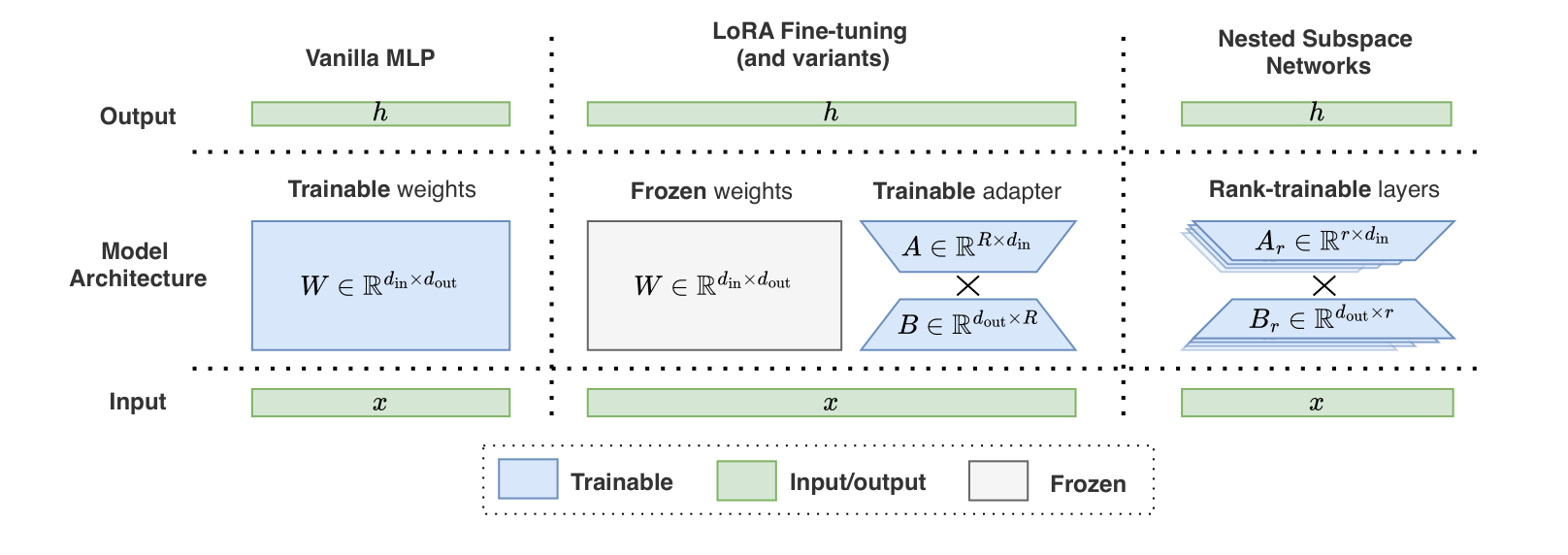
Original Figure 1. NSNs use prefixes of shared factor matrices to change active rank while preserving the layer’s input and output dimensions. Source: Section 2, CC BY 4.0.
A linear layer ordinarily applies a matrix to its input. NSNs replace that matrix with two factors and define the rank-r computation using a prefix of each:
The input and output dimensions stay fixed. Changing r changes the internal factorization width, so the layer can fit into an existing architecture without changing the interfaces between neighboring components. Shared prefixes allow lower-rank and higher-rank operating points to reuse parameters.
The paper formalizes a nested-subspace property and states conditions under which the image spaces are nested. It also makes an important computational qualification: factorization reduces a layer’s FLOPs only below the relevant break-even rank. A full-rank factorization can cost more than the original dense multiplication.
Why training across ranks matters#
Training only at a high rank and truncating afterward can destroy low-rank performance. The smaller operating points need to participate in learning rather than simply inherit an arbitrary prefix of a high-rank solution.
The proposed training procedure combines an anchor rank with a sampled lower rank. An uncertainty-aware objective learns how to weight their losses, addressing the fact that different ranks have different learning difficulty. This provides a practical way to train a useful hierarchy without evaluating every possible rank at every optimization step.
For pretrained language models, the paper replaces selected linear layers and initializes the factors through singular value decomposition. The model is then adapted using the multi-rank objective. The resulting deployment-time rank choice is inexpensive to change, but obtaining the useful hierarchy requires this preparation.
What the experiments show#
The experiments examine training objectives, interpolation between ranks, properties of the learned components, and adaptation of pretrained LLMs. The language-model studies include Pythia-2.8B, GPT-Neo-2.7B, Gemma-2B and Qwen2-0.5B. The primary Pythia analysis uses a natural-language-inference classification task.
Table 1 isolates the value of training more than one rank. It uses a classifier on fixed image features from CIFAR-10. The following selected values are reported means; the paper provides standard deviations and additional ablations.
| Objective | Highest-rank accuracy | Average trained sub-rank accuracy | Average interpolated-rank accuracy |
|---|---|---|---|
| Anchor cross-entropy only | 0.87 | 0.48 | 0.57 |
| Two cross-entropies: anchor and variant | 0.88 | 0.79 | 0.81 |
Here, “interpolated” means ranks not explicitly optimized in that experiment, not a distribution shift in the input images. The comparison supports the importance of training the hierarchy itself.
In the pretrained-LLM study, the paper reports a representative operating point with approximately 50% lower computational cost and a five-percentage-point accuracy reduction. This is a reported experimental trade-off, not a universal promise for every model, workload or hardware implementation. See Section 4.4 and Figure 7.
How this differs from LoRA and static compression#
LoRA typically learns an additive low-rank update to a frozen base model for a chosen adaptation task. NSNs use shared factors to represent multiple effective ranks of the layer itself. Their deployment objective is to support a range of compute budgets within one adapted network.
Static compression likewise produces a particular operating point. NSNs instead make the operating point a configurable part of inference. Whether that flexibility is worthwhile depends on the application’s compute–quality trade-off and the cost of preparing the adaptive model.
Scope and limitations#
The theoretical interpolation result depends on assumptions about component energy and loss regularity. It does not establish that every neural network will have a perfectly monotone task-accuracy curve at every rank. The empirical results should be read with their specific architectures, datasets and adaptation procedures.
FLOPs also differ from wall-clock savings. Factorized operations, batch size, kernels and memory access affect realized latency. A deployment should measure those quantities directly rather than translate an arithmetic reduction into an identical speedup.
Questions about the paper#
Can I truncate any pretrained LLM and expect these results?#
No. The paper specifically motivates joint training across ranks because naive truncation can perform poorly. Its pretrained-model procedure includes initialization and adaptation.
Does choosing a rank require training a new checkpoint?#
Once an NSN hierarchy has been trained, the rank can be selected within that hierarchy at inference. This is the flexibility the architecture is designed to provide.
How does this connect to least-privilege language models?#
Both use rank-controlled internal representations. NSNs focus on adaptable compute budgets; the least-privilege paper studies how a related interface can support deployment-time allocation of model capability.
Sources and implementation#
This page follows the ICLR 2026 record and the revised arXiv paper. The first preprint appeared in 2025; the conference publication is in 2026. The authors’ Nested Subspace Networks repository contains the implementation.
Use in your work
Cite this paper
Cite the original research below. This generated explanation is a reading aid.
Rauba, P., & van der Schaar, M. (2026). Deep Hierarchical Learning with Nested Subspace Networks for Large Language Models. The Fourteenth International Conference on Learning Representations. https://openreview.net/forum?id=ymUOPsbxLi
BibTeX
@inproceedings{rauba2026nestedsubspacenetworks,
  title = {Deep Hierarchical Learning with Nested Subspace Networks for Large Language Models},
  author = {Rauba, Paulius and van der Schaar, Mihaela},
  year = {2026},
  booktitle = {The Fourteenth International Conference on Learning Representations},
  eprint = {2509.17874},
  archivePrefix = {arXiv},
  url = {https://openreview.net/forum?id=ymUOPsbxLi}
}