ICLR 2026 RSI Workshop · Spotlight · Efficient architectures & inference
Tiny Autoregressive Recursive Models
Workshop paper · University of Cambridge
ICLR 2026 Workshop on AI with Recursive Self-Improvement (2026)
Original abstract
Tiny Recursive Models (TRMs) have recently demonstrated remarkable performance on ARC-AGI, showing that very small models can compete against large foundation models through a two-step refinement mechanism that updates an internal reasoning state z and the predicted output y. Naturally, such refinement is of interest for any predictor; it is therefore natural to wonder whether the TRM mechanism could be effectively re-adopted in autoregressive models. However, TRMs cannot be simply compared to standard models because they lack causal predictive structures and contain persistent latent states that make it difficult to isolate specific performance gains. In this paper, we propose the Autoregressive TRM and evaluate it on small autoregressive tasks. To understand its efficacy, we propose a suite of models that gradually transform a standard Transformer to a Tiny Autoregressive Recursive Model in a controlled setting that fixes the block design, token stream, and next-token objective. Across compute-matched experiments on character-level algorithmic tasks, we surprisingly find that there are some two-level refinement baselines that show strong performance. Contrary to expectations, we find no reliable performance gains from the full Autoregressive TRM architecture. These results offer potential promise for two-step refinement mechanisms more broadly but caution against investing in the autoregressive TRM-specific model as a fruitful research direction.
A controlled study asks where extra computation should go inside an autoregressive model. Under matched block-pass budgets, the full autoregressive TRM offers no reliable gain on the tested small algorithmic tasks; simpler depth and two-stream alternatives perform better.
Where should extra computation go inside an autoregressive model?#
Giving a model more computation can mean very different things. It might mean adding distinct layers, repeatedly applying a shared block, maintaining two interacting hidden states, or refining a latent solution several times before predicting the next token. If those alternatives also change the training objective or available information, a performance comparison becomes difficult to interpret.
Tiny Autoregressive Recursive Models studies compute placement in a controlled autoregressive setting. It adapts the refinement mechanism associated with Tiny Recursive Models and compares it against a sequence of simpler architectures. The central finding is a negative result: the full autoregressive TRM does not provide a reliable advantage in the small, compute-matched algorithmic experiments reported here.
A controlled ladder of architectures#
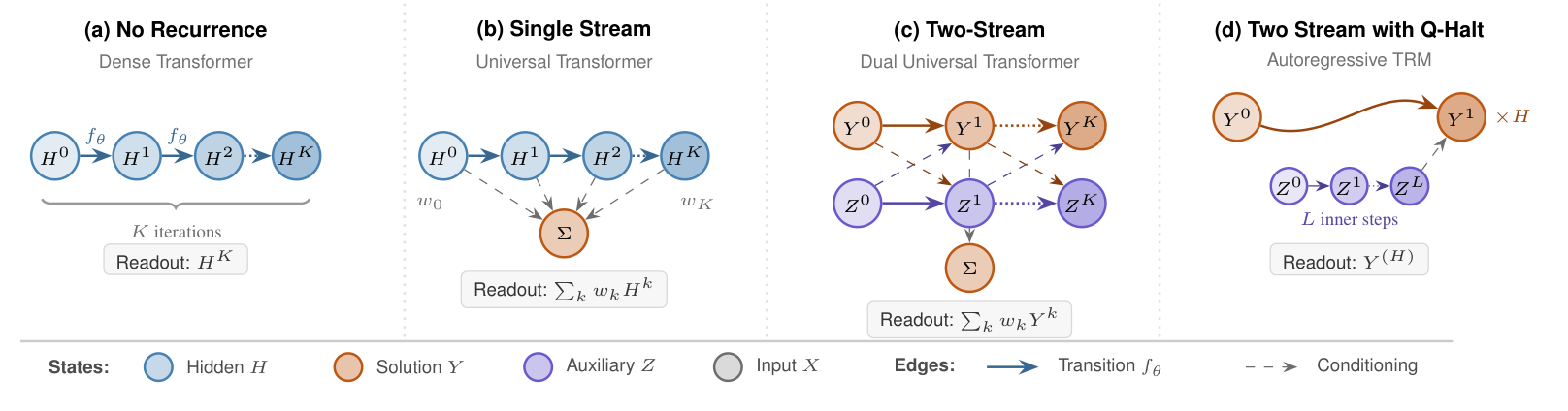
Original Figure 2. The architectures vary how computation is organized while preserving a common autoregressive task. Source: paper, page 2, CC BY 4.0.
The study holds the token stream, next-token objective, decoder-block template and causal masking fixed. It then introduces changes incrementally: weight sharing, step conditioning, adaptive readout, a second hidden-state stream, nested refinement and halting behavior. This makes the comparison more informative than contrasting two systems that differ on all of those axes at once.
Compute is matched through the number of decoder-block evaluations. Parameter count alone would be insufficient: a small shared block can be executed many times. Matching block passes makes the amount of executed computation explicit within the controlled family.
Adapting a solver-style TRM also requires care about information flow. The autoregressive construction enforces causal masking and removes cross-call latent carry by reinitializing the latent streams on each forward pass. The model must predict from the permitted prefix rather than gain access to future tokens or additional persistent information.
What the experiments show#
The experiments use character-level Addition, Copy and Reverse tasks. They evaluate generalization under changes in sequence length, with measures including character accuracy, sequence exact match and errors at different output positions.
The selected results below are from Figure 3, at length 10 under the paper’s matched block-pass setup. They are character accuracies, not sequence-level exact-match scores.
| Architecture | Addition | Copy | Reverse |
|---|---|---|---|
| Dense Transformer | 80% | 100% | 100% |
| Universal Transformer | 66% | 100% | 100% |
| Autoregressive TRM | 12% | 11% | 10% |
The full controlled ladder provides further context. Untied depth and a flat two-stream recurrent baseline give the strongest generalization per block evaluation in the reported experiments. Several recurrent or nested variants encounter late-output bottlenecks. The paper uses position-wise errors and learning curves to investigate where those failures accumulate, rather than relying only on an overall score.
This makes the result useful even though it does not establish a new performance leader. A promising mechanism in one setting does not automatically transfer to another. The study separates evidence for simpler two-stream refinement from evidence for the particular nested autoregressive TRM construction.
Why this matters for recursive reasoning research#
“More reasoning” is often used to describe several distinct interventions: longer generated chains, deeper networks, recurrent hidden-state computation, or internal solution refinement. This paper provides a way to ask a more specific question about those interventions while keeping the autoregressive learning problem fixed.
For researchers designing efficient models, the lesson is to compare against strong, compute-matched alternatives and inspect which component accounts for an apparent gain. A smaller parameter count is not automatically a lower inference cost, and adding a hierarchy is not automatically a better use of repeated block evaluations.
Scope and limitations#
The negative finding applies to the tested small models, character-level tasks and training regimes. It does not establish that every recursive architecture fails, that larger autoregressive systems cannot benefit, or that the original non-autoregressive TRM results are invalid.
Block-pass matching is a controlled proxy for compute. It does not replace measuring wall-clock latency, memory use and throughput on a production implementation. The results are also about supervised next-token training; they are not evidence about asynchronous reinforcement learning or long-horizon RL training.
These boundaries make the conclusion more useful: the specific tested architectural transfer did not deliver the expected benefit, while some simpler allocation schemes remain promising.
Questions about the paper#
Does the autoregressive TRM outperform a standard Transformer?#
Not in the reported compute-matched algorithmic experiments. The paper explicitly reports no reliable gain from the full autoregressive TRM construction.
Is the study about adding chain-of-thought tokens?#
No. It holds the token stream fixed and changes internal computation. Adding extra generated tokens would change the comparison the paper is designed to isolate.
Why include a negative result in this collection?#
The result helps identify which architectural mechanisms warrant further investment and which claims require stronger evidence. Its controlled comparisons are part of the contribution.
Sources and implementation#
The paper is arXiv:2603.08082, presented as a spotlight at the ICLR 2026 Workshop on AI with Recursive Self-Improvement. Sections 3–5 describe the construction and experiments; Figure 3 supplies the table above. The paper links to the public autoregressive-TRM implementation.
Use in your work
Cite this paper
Cite the original research below. This generated explanation is a reading aid.
Rauba, P., Fanconi, C., & van der Schaar, M. (2026). Tiny Autoregressive Recursive Models. ICLR 2026 Workshop on AI with Recursive Self-Improvement. https://openreview.net/forum?id=aY5kmaNrwB
BibTeX
@inproceedings{rauba2026tinyautoregressiverecursivemodels,
  title = {Tiny Autoregressive Recursive Models},
  author = {Rauba, Paulius and Fanconi, Claudio and van der Schaar, Mihaela},
  year = {2026},
  booktitle = {ICLR 2026 Workshop on AI with Recursive Self-Improvement},
  eprint = {2603.08082},
  archivePrefix = {arXiv},
  url = {https://openreview.net/forum?id=aY5kmaNrwB}
}